Showing posts with label economics. Show all posts

Friday, October 1, 2010

Research Material on Medieval Economies

Today I received three used books in the post purchased to help me research the ins and outs of medieval urban life:

"The Commercial Revolution of the Middle Ages, 950-1350" by Robert S. Lopez.

"Medieval Cities, Their origins and the Revival of Trade" by Henri Pirenne.

"Economic and Social History of Medieval Europe" also by Henri Pirenne.

All three look quite helpful. I've already started the Lopez book which 20 pages in seems like a quick and surprisingly entertaining read. The conclusions Lopez makes confirm that I'm on the right track. (Very reassuring!) He has some interesting material on post-Roman barbarian economics which will soon become a post here much like the manorialism posts for you Conan and orc marauder types. I'm getting a lot of new-to-me information on the Roman Empire and some context on today's credit driven economy as well. Hopefully, the Pirenne books will be as inspiring.

I read "Life in a Medieval City" by Frances and Joseph Gies years ago and found it great fodder for D&D background material. I recommend it if you're into this sort of thing.

Saturday, September 11, 2010

On the Use of Guild Marks as Sympathetic Fetishes

"In Ilova, the City of False Doors, it is the custom of the Honorable Fraternity of Bakers and Pâtissiers to brand freshly baked loaves of bread from their ovens on one end with the Sigil of the Tortoise and the other end with the Sigil of the Hare. These marks serve to identify the loaves as legal goods free of taxes and are the subject of much superstitious speculation by the hungry Ilovian populous. In the markets, wandering among the citizens adorned in their funereal togas, one can hear much talk of the boons, ills and sundry other effects attributed to whether one spreads one's lard across either the tortoise side or the hare end of this bread. In fact, the sigils do serve as sympathetic fetishes to aid in targeting the loaves for enchantment by the guild Athermancers in accordance with the Laws of Contagion. These rituals can aid or hinder the rising of the bread, the length of its life upon the shelf and even, once consumed, the vigor of its consumer. It is by these means that the Honorable Fraternity of Bakers and Pâtissiers and her sister guilds exert influence and direction over the welfare of the entire economy, all at the behest of the Grand Guilder and High Officers of the Greater Confraternity of the Plen River Traders."

From The Codex of Surviving Imperial Livery Patents of Moranth, circa 17 AC.

Game Effect: Upon entering a city in which a single Guild controls the majority of the economy, make a saving throw to resist the effects of the arcane policy control mechanisms in currently place. To randomly determine the current policy effects, roll a d10: 1-3: -1 to skill checks, 4-6: no effect, 7-0: +1 to skill checks. These effects remain in place until the character leaves the city or until the end of the season. Abilities and powers which grant additional saving throws may be used to negate these effects normally.

The Post In Which Guilds are Sundered in Twain

For the last few weeks I've been at an impasse as to how to proceed with highest levels of economic activity for my game world. My original idea was to create a plausible system of economics linking the small scale of manorial production of actual goods to the larger, playable game pieces of Birthright style guilds. My feeling has been that guilds have been rather poorly defined in both description and game mechanics. Are they confederations of several small livery companies? If so, how deep down does the regents control extend into, say, the inner workings of the Honorable Fraternity of Bakers and Cake Frosters? The Hanseatic League seems like the best historical analog for a guild but along a more mono-despotic vein. The regent acts as both CEO and Chairman of the Board of a holding company composed to numerous sub-guilds who shoulder the gritty responsibility of the realities of production and labor. That leaves our regent free to... to what exactly?

I had assumed to make money. It's becoming clear with research that is a false assumption. Or rather it's better to say, their ideas on the production of wealth are far from my modern views on wealth. Guilds practiced mercantilism, not capitalism. They were strict monopolists wielding letters patent to force out and stifle competition and innovation. Foreign trade was considered a bane unless the exports always, always exceeded the imports. (An unrealistic as well as undesirable goal.) They imposed strict social order to control the balance of haves and have nots. They saw ruthless development of internal markets as the only route to wealth and when these markets stagnated, acquisition of foreign markets by force of arms was the common solution. Guilds were less concerned with money than they were with control.

And here I was trying to figure out how they profited on the free market. Under the guild system, the free market and the black market are both the same and criminal. Guilds are really a type of urban law holding. Criminal networks and the traditional D&D thieves' guilds are where the real inter-realm economic trade action is at, which is good as far as dramatic purposes are concerned. It looks like I'll be splitting the Birthright guild into two pieces and repurposing them into new roles.

Sunday, August 15, 2010

World Building: Macro-economics (Part 2)

(Updated)

This post is a dump of fairly raw data on the amount of goods produced by a manor.
This data is meant to be scaled up to the province level, not detailed down to Harn-like granularity. My long term aim is to create price indexes for a few broad ranges of goods from which I can derive prices for items on the equipment lists and for trade should the player wish to try their hands as merchants. The information here will be used to set the production values of the base index.

The manor produces Food, Metals, Raw Textiles and Timber and exports these items to local urban centers where they are consumed or worked by craftsmen into manufactured products. These are the average amounts produced per manor, not every manor's output will be strictly as described below. In a small barony of five manors there may be only one mining operation which produces 1500 lbs of metal per year and no mining at all in the other manors.

Amount of Food:
  • 1 acre produces on average 500 lbs of foods per year.
  • A person consumes about 5 lbs of food per day.
  • 20 acres supports 1 family adult and dependents with 10000 lbs of food per year or 5 tons. (Includes feed and seed.)
  • A manor of 100 feeds 50 city families which is 500000 lbs of food per year or 250 tons.
  • This food is produced on 3000 acres.
  • Includes grains, meat, grapes, milk, fruit, etc.
Amount of Metal:
  • Iron produced at 3 pounds per capita per year.
  • A manor of 100 produces 300 pounds per year.
  • This is mostly iron but can include gold, silver, copper, tin, zinc, etc.
Amount of Textiles, Furs, Hides:
  • Linen from flax.
Flax 1000 lbs per acre of which there is spinable flax for 25 yards of linen.
5 yards per outfit.
Acres of flax per manor = 10% of 3000 = 300 acres which produces 150 tones per year or 7500 yards of linen or 1500 outfits.
  • Leather
Pigskin is common.
10' sq per pig.
400 pigs per manor, 25% butchered a year.
50 lbs of meat per pig
5000 pounds of meat per year or 2.25 tons (as apart of total food)
1000' sq feet pigskin or ~100 yards of leather, 20 outfits.

Cowskin from naturally loses only, i.e. 10% of herd.
Herd of 100 cattle.
40' sq feet per cow
400' sq ft leather per year
~45 yards of leather or 9 outfits

Deer, Elk
Hunt 50 a year
20' sq feet per animal
1000' sq feet deerskin or ~100 yards of leather, 20 outfits.

Sheep
200 sheep per manor, 10% loses
5' sq ft leather
10 lbs of fleece per year, 15 yards of wool or 3 outfits
2000 lbs of wool per year or 1 ton or 3000 yards or 600 outfits
100' sq ft or 9 yards or 2 outfits

  • Furs (beaver, rabbit, fox, ermine, etc)
Hunt 50 per year
~4' sq ft furs
20 yards per year

Amount of Timber:
  • 200 trees per acre, 30' tall 10" diameter, 500 lbs. or 100 tons per acre total.
  • Sustained harvest at 10% = 20 trees weighing 10000 lbs. or 5 tons.
  • 200' board feet per ton. (Board feet 144" cubed.) 10' 2"*4" is 960' cu. is 6.66 board feet.
  • 10' by 10' wooden wall (30 2*4s) is 200 board feet.
  • Acres of timber per manor = 10% of 3000 = 300 acres which produces 1500 tones per year.
  • A 20' by 30' for wooden house requires 22 tons of raw timber.
  • 1 urban family burns 20 tons of wood as fuel per year reducing available timber to 500 tons per year.
  • Building upkeep for 100 dwellings reduces available timber by 200 tons.
  • 300 tons of timber available per year.
Total yearly exports of a manor:
  • Food: 250 tons (Mostly grains, some meat, fish)
  • Metal: 300 lbs (Mostly iron)
  • Textiles: flax for 7500 yards of linen, 3000 yards wool, ~250 yards of leather (Pig, Deer, Cattle), 20 yards of furs (Beaver, Rabbit, Stoat)
  • Timber: 300 tons
Total Value of Exported Goods: ~1800 GP per year
  • Food 1CP @ 50lbs - 100 GP
  • Metal(iron) 2GP @ lbs - 600 GP
  • Timber 1GP @ ton - 300 GP
  • Flax 1GP @ "42 yards" - 180 GP
  • Wool 1GP @ "25 yards" - 120 GP
  • Leather 1GP @ "1.5 yards" - 375 GP
  • Furs 10GP @ "1.5 yard" - 133 GP
Next post will look at urban wages and will determine prices for common adventuring items based off the information provided here.

Wednesday, July 14, 2010

World Building: Politics and Macro-economics (Part 1.5)

Establishing the Gold Standard

The Tao of D&D author Alexis' posts on his extremely detailed economic system have been a large influence on my thinking for the economic system in my campaign. In his recent post Let's Try It From The Beginning Again he summarizes his approach. While I'm not interested in the achieving the same level of granularity his system explores, I am fascinated by some of the mechanics he uses. In the comments of his post, I asked,

"How do you define the total gold in the system? Does it include non-circulating coin such as in a dragon's horde or buried beneath the sands of a lost city? If players recover a significant amount of wealth and spend it, do you add it to the system? Do you have any mechanic for varying the amount of gold in the system via loss or new mines?"

His response was,

"I calculate my total gold in the system by the use of the United Nations International Statistics Yearbook 1988, which gives the gold produced for that year as 1,771,000 kg. In comparing 1988 with 1650, research I’ve done suggests that the increase in industrial production during that period increased approximately 50,000% ... giving me a nice, round number with which to divide; so 1,771,000 kg over 500 gives approximately 311,000 oz of gold distributed through my system (I use imperial measurements for my world, so the metric is converted).

I’m not dead sure about those numbers, I don’t have my work in front of me, but it is somewhere around those.

It does not take into account ‘circulating gold,’ which I estimate is 9 times the gold produced in a year ... this based on the principle that 1% of all made or resourced material becomes unusable per month. This doesn’t hold for agricultural goods, obviously, but I overlook that because the system demands as much simplification as possible, and I don’t give a shit. I get around the issue by comparing the total gold produced in one year against the total of everything produced in one year.

(adjusted, of course, for industrial development to 1650)"


I'm particularly impressed with his 1% monthly loss rule which elegantly and simply solves a nagging worry I had about "excess" wealth building up.

But another worry of mine is that while Alexis is conquering his entire world, I'm only taking on an Europe-sized section of mine and I need to develop a system of determining the circulating wealth of this fractional land. I have attempted to solve this problem by determining an average gold production per capita.

I started with some numbers on the Roman economy and picked 9 tons (288,000 ounces) of gold output per year and a population of 50 million which gave me 0.00576 ounces of gold per person a year which I rounded up to 0.006. The average mass of a gold coin I set at 5.7 grams or 0.201061583 ounces giving me 5 GP per ounce.

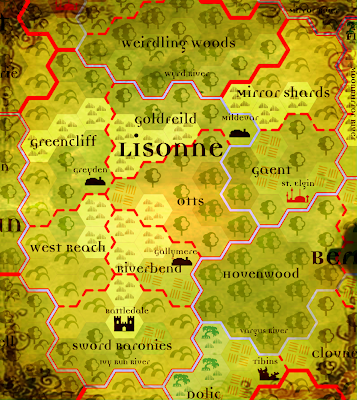
Now let's look again at domain Lisonne and populate it:


Name Level Population Coin
Gaent 7 60k 18000 gp
Goldfeild 4 10k 3000 gp
Greencliff 5 20k 6000 gp
West Reach 2 4k 1000 gp
Riverbend 6 30k 9000 gp
Mirror Shards 3 7k 2000 gp
Otts 3 7k 2000 gp

The coin column is the amount of hard currency in the province as determined in the last post.

Lisonne has a total population of 138000 people and should have 41000 GPs worth of coin in circulation. But can our gold production numbers support that? Let's find out: 138000 times 0.006 gives us 828 ounces or 4140 GP of yearly gold production. Multiply that by 10 to find the total amount of gold in circulation and we get 41400 GP. Not bad at all! It certainly gives me confidence I'm on the right track.

Next post in this series will detail the actual goods tracked and why, the effect of distance on price, the effects of borders and law level on trade and how I'm setting myself up for coding up some complicated shortest path algorithm in the near future.

Cheers!

Thursday, July 8, 2010

World Building: Politics and Macro-economics (Part 1)

The economy of the fantasy world in which my campaign is set consists of a network of interconnected economic forces: the feudal system, the guild controlled markets of the free cities, the economics of the various church holdings and the working of the various non-human cultures. Each one has its own unique political structure. Part one of this series will focus on the sub-economy which is among the most self-sufficient and the most familiar to players of fantasy RPGs.

(A warning for those playing editions in which characters gain experience through the acquisition of gold pieces; the economic system about to be described was not designed with character level advancement in mind. I suspect that this system will hinder character leveling if strictly followed and will collapse if characters are given enough wealth to level normally.)

Feudal Economics

Building from the previous series, we have obtained the population levels from the building block of manor farm to the level of the province. Now we will determine the economic power for those holdings.

The Economics of the Manor

The manor is mostly capable of supporting its self. Any surplus raw goods it produces, it trades with urban economy and receives manufactured items or coin in return. The value of a manor's agricultural surplus is based on the following:

The raw material cost of supporting the family of one urban dweller of average means equals one silver piece per day.

The cost per month is thus three gold pieces and the yearly cost is 36 gold pieces or 9 gold pieces a season. With the 1:2 urban to rural population ratio we previously established, it takes two rural farmers to produce this wealth. A manor house with a population of 100 could thus produce an agricultural surplus worth 450 GP a season and 1800 GP a year. Note, much of this wealth is in perishable form, such as taxed grain. We'll say only half one-tenth is in coin. Most coinage in circulation is copper and silver. Gold is very rare and platinum is never seen.

Each season, the lord of the manor may choose to tax this production lightly (1/4), moderately (1/3) or severely (1/2) and collect 112 GP 5SP, 150 GP or 225 GP respectively. The remainder is then divided among the manor population. With moderate taxation, 300 GP of value is returned to the community of 100 per season.

It follows that the family wage of an average rural dweller is about 3 copper pieces per day.

These wages are not completely out of step with the price list given in the 4e PHB. It helps to think of the value of a single copper piece as worth about 1 to 5 USD. One may think at first that the value of a longsword (15 GP) may be a bit steep (over 1500 USD) but its modern equivalent, an AR-15 assault rifle, costs about that much. Some items listed are off base, I think, like the longbow is probably far over-priced. Certainly player starting funds are far too high. Continued use of the existing treasure bundles listed in the 4e DMG is suggested. Characters who are actively adventuring are bound to get very rich, very quickly in comparison with manor bound landlords but the risks should offset the rewards. ;)

An important part of a manor lords obligation to his liege is his military service. It is in meeting this obligation that entire manor system exists. The wealth a manor generates in coin is not its only output; it provides the following military might for one season's worth of campaigning a year:

1 knight (manor lord) 10th level leader/soldier - Heavy Cavalry
2 knights bachelor 5th level soldiers - Heavy Cavalry
3 squires 3th level soldiers - Light Cavalry
1 cleric 3rd level leader/controllers - Medium Foot
10 Yeomen militia 1st level minions - Medium foot or Archers
17 total, 6 mounted, 11 foot

Can I get a stat box, please: Yikes, nevermind...

Manor, Low level law holding
A manor is a self-sufficient stationary estate, or fief that is under the control of a lord who enjoys a variety of rights over it and the peasants attached to it by means of serfdom.
Military
1 knight (manor lord) 10th level leader/soldier
2 knights bachelor 8th level soldiers
3 squires 3th level soldiers
1 cleric 3rd level leader/controllers
10 villein militia 1st level minions
17 total, 6 mounted, 11 foot
Buildings
1 manor house, fortified on 4, 5, 6 on d6
d4 manor out buildings
d4 craftsmen workshops
1 communal stockade
1 church, fortified on 5, 6 on d6
5d6 + 6 Small houses or huts
Goods Available
Food and drinks
Farm livestock
Clothing and material
Simple melee weapons
Military and simple ranged weapons
Leather armor
Simple tools
Population 100
Income per season 450 GP
GP Limit 225


Politics and Management below the Provincial Level

We will now build bigger political units such as baronies upon our manor base. First we should look at the limits of what a character can control directly and the political structure that has developed to extend the limits of power.

A character, PC or NPC, may only directly manage five (plus or minus the character’s int modifier) holdings or vassals directly. Vassals are limited by this rule as well. A manor lord at least holds the rank of knight. A manor lord granted more than one manor is usual also given the title of baron or baronet. Those with noble titles may invest lesser titles upon their own vassals. A vassal baron or baronet may control up to five manors. A viscount may control up to five barons or manors. A province is ruled by a count who may control up to five viscounts, barons or manors.

When a character grants holdings to vassals, the character loses the direct income on those holdings but may tax his vassals at 1/4, 1/3 or 1/2 of their incomes and can require the normal season of military service from them and any sub-vassals. If a vassal uses his sub-vassals' season of military obligations and is later called upon by his liege to provide all his military obligations, the vassal must pay his sub-vassals for their additional service or he risks angering his liege. Manors granted to a vassal may be scattered across the land, which may be desirable if the liege doesn't fully trust his underlings to concentrate their base of power.

For example, if a character, a viscount, controls 12 manors, he may directly manage 3 manors and must divide the remaining nine between two vassals as each vassal is also limited to five direct holdings. He invests two new barons and grants them five and four manors each. He loses the the direct income on the nine manors but my tax his new barons' income on those manors. The first baron provides 5 sub-vassal knights, 10 knights-bachelor, 15 light cavalry, and 55 footmen. The second baron provides 4 sub-vassal knights, 8 knights-bachelor, 12 light cavalry and 44 footmen. Both barons set moderate tax rates and earn incomes of 750 GP and 600 GP per season. The viscount taxes the first baron heavily for 375 GP and the second baron lightly for 150 GP and receives an income of 300 GP by moderately taxing his own manors. He receives a total of 825 GB this season and has 2 barons, 10 knights, 24 knights-bachelor, 36 light cavalry and 132 foot at his call. He may, in turn, be taxed by his liege, the count.

At this point, we have determined the average income of a lowly villein to that of a count!

Information at the Provincial Level

Let's review the Provincial population chart:

PROVINCE LEVEL
Level Population Largest Settlement
0 <> Thorp
1 1000 Hamlet
2 4000 Village
3 7000 Small Town
4 10000 Large Town
5 20000 Large Town
6 30000 Small City
7 40000 Large City
8 60000 Large City
9 80000 Metropolis
10 100000 Metropolis

Suppose we have a province with a population level of three ruled by a count. Of the 7000 able-bodied souls in that province we know that 2 in 3 are apart of the feudal economy. That gives us about 4620 people living on about 46 manors. With 46 manors, we know there is about 20,700 GP floating about in the local feudal economy of which only half one-tenth is in hard currency. (All those copper pennies...) There are probably nine barons in the province, and at least one viscount beneath the count.

I'm tempted to go into law holdings and domain play at this point but I think I'll save that for after the current series.

Thanks for reading!

Update (7/14/10):

I reduced the fraction of hard currency of the total wealth from one-half to one-tenth. I suspected one-half was a bit high and while doing the numbers for the next post I discovered a happy reinforcement between the one-tenth of total wealth number and a separate calculation for the total amount of actual gold in the system.