Showing posts with label 5 mile hex. Show all posts

Wednesday, October 6, 2010

Prospecting for Metals

Access to rare metals could make or break the fortunes of a civilization. When PCs wish to secure a stronghold, it is natural they should seek out these resources. Propecting on their own holdings may reveal hidden sources of stability and wealth.

Prospecting requires a successful 5th level complexity one skill challenge. (The skill challenge is a 4e mechanic but can be adapted to any AD&D edition with the use of nonweapon proficiencies or skills.)

Prospecting for Metals Skill Challenge (5th Level)
Prospecting is time consuming, back breaking work with little chance of overnight success. Long hours are spent in cold mountain streams and dismal bogs sifting for rare materials.

Complexity:
1 (4 successes before 3 failures)
Primary Skill:
Dungeoneering - Moderate 5th level DC (15)
Secondary Skills:
History (1 use) - gives +2 bonus, Knowledge of past assay attempts.
Perception (1 use) - gives +2 bonus, A close eye is kept out for tell tale signs.
Endurance (1 use) - gives +2 bonus, Extra hours of back breaking labor.
All Moderate 5th level DC (15)
Time Required:
1 month
Area Covered:
1 five mile hex
Success:
One roll on the METAL PROSPECTING CHART.
Failure:
No results.
Reward:
200 XP

METAL PROSPECTING CHART (d100)
% chance / metal / frequency
01-94 Nothing of value in this area.
95-99 Iron 5% of Crust
00 Roll on RARE METALS CHART

RARE METALS CHART (d100)

% chance / metal / frequency
01-50 Zinc 75 parts per million
51-91 Copper 60 ppm
92-97 Lead 10 ppm
98 Tin 2 ppm
99 Arsenic 2 ppm
00 Roll for VERY RARE METALS CHART

VERY RARE METALS CHART (d100)
% chance / metal / frequency
01-57 Antimony 0.2 ppm
58-78 Silver 0.08 ppm
79-97 Mercury 0.07 ppm
98 Platinum 0.004 ppm
99 Gold 0.003 ppm
00 Roll for FANTASIC METALS CHART

FANTASIC METALS CHART DM's Pick
metal / suggested effect
Fey Iron (Radiant)
Shadow Iron (Necrotic)
Star Iron (Psychic)
Orichalcum (Force)
Mithril (lighter)
Adamantium (stronger)
Uxoricore (Fire)
Uru (Thunder)
Black Orichalcum (Psychic, Force)
Etc...

Prospecting is a time consuming undertaking and the appropriate random encounter rolls should be made.

Once a metal is discovered, it must be extracted which I'll detail in a future post. Placer mining was the most common method but shaft mining is also a possibility, especially in Dwarven operations.

I leave it to the DM to determine the details of any fantastic metal discovered but the rewards for successful extraction should be significant.

These charts should be taken with a grain of salt. For example, historically lead was collected at several times the quanity of copper, despite being more rare. This probably was because lead was in some way easier to extract than copper. Also, lead was often found with other metals such as copper, zinc and silver but this chart only produces a single metal on a successful role.

For more detailed information on various metals one might encounter in a D&D game, check out the recent post on The Tao of D&D about mining and metals.

Tuesday, April 6, 2010

World Building, Mapping and Population (Part One)

This first in a series of posts describing a simple system of determining the maximum population levels of large hex-based map areas inhabited by cultures with a High Middle Ages style technology and culture. This is good for European-like human or even halfling lands but is not really suitable for barbarian cultures, elves, and more magical based societies.

This system makes two important major assumptions:
  1. The primary means of agricultural production is the manor house which entails open field farming with two crop rotation and communal serf labor.
  2. The rural to urban population ratio is 2:1. Every two farmers can feed one urban dweller.
This post focuses at the foundation levels of land use at the 1 mile hex and the 5 mile hex scale.

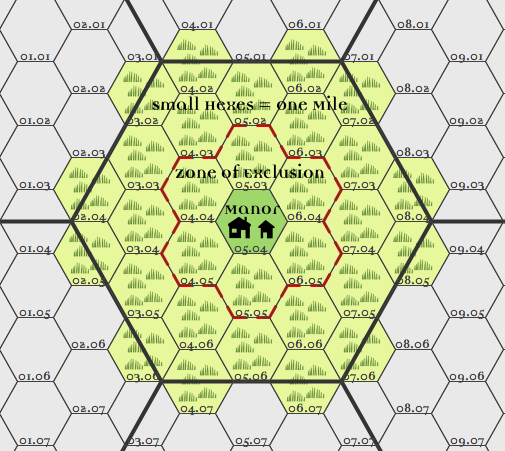
Each manor has a population of 100 able bodied adults and occupies one 1 mile hex. In each of the hexes surrounding it, there is a zone of exclusion in which no other settlement may occupy. Two manor's zones may overlap however. This zone represents the area in which shepherds graze animals, game is hunted and firewood is collected. All of the inhabitants are considered apart of the rural population regardless of occupation or station. Most of the population are serfs with limited personal freedoms. Each manor consists of a manor house, a small hamlet, a church, a few craft workshops such as a small smithy and a perhaps mill. It farms approximately 500 acres of land and may have a small scale mining operation on the side as well. This sort of settlement has been well described in Dungeon and Dragon terms in The Village of Hommlet.


Villages are the smallest self-sufficient urban settlements and contain the hexes' urban population. It occupies one 1 mile hex and in each of the hexes surrounding it, there is a exclusive zone of exclusion which can not be shared with any other settlement. The total population of the village is 350 able bodied adults. 100 of these villagers are engaged in the same sort of rural activities as manor populations and the other 250 villages are the hexes' urban dwellers. They urban population is engaged mostly in trade and manufacture. All of the village population are considered freemen.


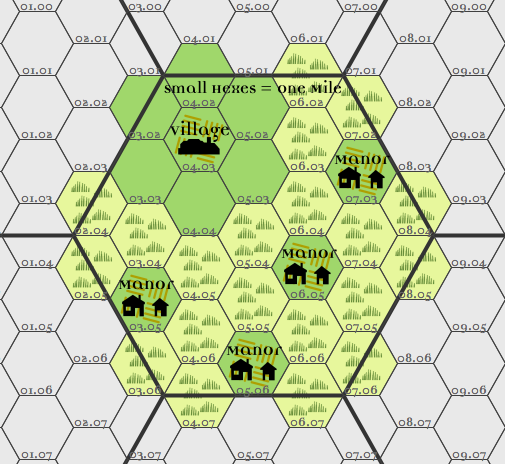
Here is an example of a 5 mile hex with the maximum self-contained population level of 750 able-bodied adults living in 4 manors and and one village:


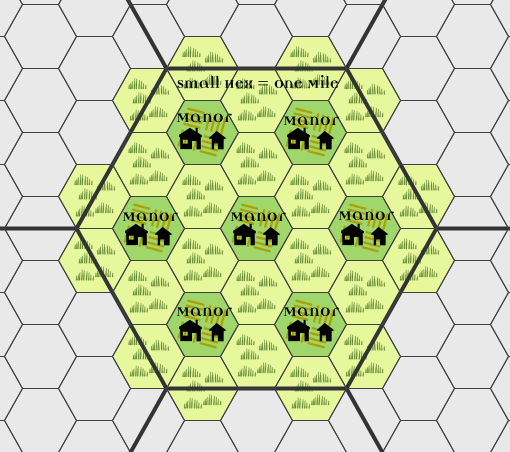
Here is an example of a 5 mile hex supporting a maximum population level of 1050. 700 able-bodied adults live in this hex in 7 manors and they are able to support 350 urban dwellers in a town or city in a nearby hex:


Each town or city occupies at least one 1 mile hex and has a zone of exclusion extending for two hexes around it that can not be shared with any external settlement. Small suburban settlements may be located within the zone of exclusion but their population must be included in the total population of the main town or city. Thus, towns and cities occupy one 5 mile hex in total.

In any settlement larger than a village, the entire population is considered urban and totally reliant on imported food from the country side. Dungeons and Dragons defines towns as having populations of 1000 people or more so the smallest town would require a minimum of 21 manor houses to support its citizens. If those manors were packed together at maximum density they would require three 5 mile hexes of plains.

The next post will look at population on the 25 mile hex scale and at Birthright style provinces. Also, terrain will be consider in determining the maximum amount of arable land.

Related links: